Weather in Seyðisfjörður, and What Happens When a Trip Is Called Off
Seydisfjordur weather comes down to two numbers. The town takes over 1,650 mm of rain a year, about twice Reykjavík, and the only road out crosses a pass at 600 metres. Trips run in conditions that would stop them elsewhere, and when they do not run, the money question has a straightforward answer. This page covers the climate you are actually booking into, when the road shuts, and what a cancellation is worth.
Quick answer
Seyðisfjörður averages over 1,650 mm of rain a year, with October the wettest month at 214 mm and June the driest at 56 mm. Day highs run from 3°C in January to 13°C in July. The Fjarðarheiði pass at 600 m closes in winter storms and occasionally to avalanche risk in spring. Every guided trip listed from the pier cancels free up to 24 hours ahead and takes no payment at booking, so a cancelled trip costs you nothing but the day.
Key takeaways
- Annual rainfall over 1,650 mm, which is roughly double Reykjavík
- Wettest month October at 214 mm; driest June at 56 mm
- Day highs 3°C in January and 13°C in July, so the range across a whole year is about ten degrees
- The pass shuts in winter storms, sometimes for days, and can close to avalanche risk in spring
- Rain alone rarely cancels a trip here. Wind, ice and a closed road do
- Free cancellation up to 24 hours ahead on every trip listed, with no payment taken at booking
The Climate You Are Booking Into
Figures from the Icelandic Met Office record for Seyðisfjörður. Last verified: July 2026.
| Month | Day high | Rainfall | Notes |
|---|---|---|---|
| January | 3.0°C | 211 mm | Storm closures on the pass |
| February | 2.9°C | 156 mm | Coldest month on average |
| March | 3.1°C | 161 mm | Ferry season opens |
| April | 4.7°C | 94 mm | Drying out, puffins arrive |
| May | 8.4°C | 67 mm | Cruise season opens |
| June | 11.3°C | 56 mm | Driest month of the year |
| July | 13.0°C | 57 mm | Warmest and busiest |
| August | 13.2°C | 95 mm | Warm, wetter, puffins leave mid-month |
| September | 10.0°C | 173 mm | Rain returns, season winds down |
| October | 6.4°C | 214 mm | Wettest month, last calls |
| November | 4.4°C | 178 mm | Winter closures begin |
| December | 2.7°C | 189 mm | Around four usable hours of light |
The range across the whole year is about ten degrees, which is unusual and useful: you are packing for one kind of weather rather than four. What varies is not the temperature but how much water is in the air and how hard it is moving.
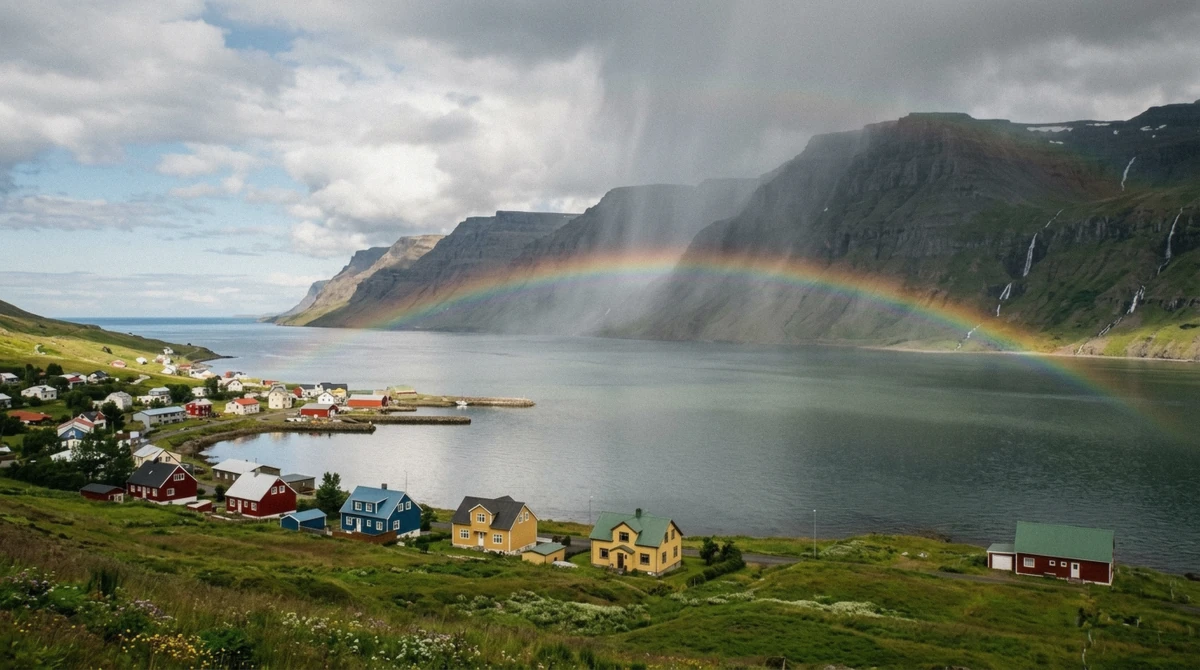
The mountains do the rest. Mount Bjólfur stands 1,085 m on one side of the town and Strandartindur 1,010 m on the other, and a fjord this narrow funnels wind and holds cloud. It can be raining in the town and dry at the canyon ninety minutes inland, which is why guides reorder stops rather than cancel.
What Actually Stops a Trip
Not rain. Operators here run in weather that would close an attraction in most of Europe, and the reviews from July are full of groups who went out in it and had a good day. Four things do stop a trip.
- The pass. Route 93 crosses Fjarðarheiði at 600 m and closes in storms, sometimes for days. Nothing inland runs when it is shut
- Wind on the water. The fjord cruise is the first thing cancelled, because the mouth of the fjord is open to the Atlantic
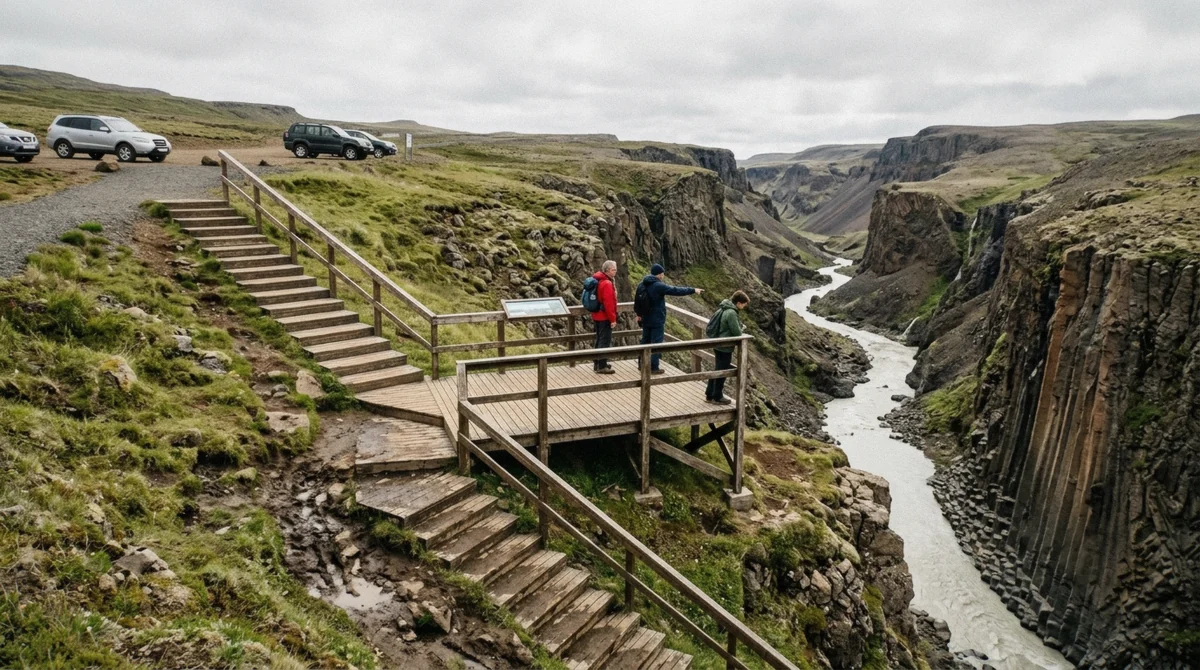
- Ice on the canyon descent. The east-side path has fixed chains for a reason and freezes early in the season
- Your ship. If a call is dropped or shortened for weather, every trip booked against it goes with it
What happens instead
Guides reorder rather than abandon. One group in July had the waterfall moved to the start of the day when rain was forecast for the afternoon, and beat the crowds as a side effect. Another had their ship switch to tenders on the morning of the trip, everyone left late, and the guide reworked the timings so the group still saw everything.
That flexibility is the practical argument for a trip with a small operator over a fixed schedule. It is also why the itineraries on the booking pages say the order of stops may change with weather and road conditions, and mean it.
What a Cancellation Is Worth
The terms are the same across every trip listed from this pier, which makes the arithmetic simple.
| Situation | What happens | What it costs you |
|---|---|---|
| You cancel more than 24 hours ahead | Full refund, and nothing was charged at booking | Nothing |
| You cancel inside 24 hours | Standard terms apply, refund not guaranteed | Potentially the full fare |
| The operator cancels for weather | Refunded in full | Nothing |
| The road is closed | Operator cancels and refunds | Nothing |
| Your ship skips the port | The trip cannot run and is refunded | Nothing |
| You miss the departure | Treated as a no-show | The full fare |
Two things follow from that table. Booking early costs nothing, because no payment is taken at the time and the cancellation window is generous, so holding a seat on a popular coach is free optionality. And the only expensive outcome on the list is missing your own departure, which is a tender-queue problem rather than a weather one and is covered on the cruise port guide.
Who decides, and how you hear
Operators call it in the morning rather than the night before, because the fjord makes its own weather and yesterday's forecast is often wrong in both directions. The message comes to the phone number and email on your booking, so a working phone in Iceland matters more here than in most places.
If a trip is called off you choose between a later departure and a full refund, and nothing was charged at booking in the first place. What no operator can do is hold a boat for a passenger whose bus or ship is late, because the return leg is fixed against the ferry and cruise schedule rather than against a clock.
Planning Around the Weather
Small habits that change how a wet day goes.
- Check the road forecast for Fjarðarheiði the morning of any inland trip outside high summer
- Book the earlier departure on a call day, so a delay has somewhere to go
- On a tendered call, take a five-hour trip rather than a seven-hour one
- Carry the waterproof even when it is sunny at eight in the morning, because the fjord makes its own weather
- Keep a dry layer in the daypack rather than on your back
- Treat any plan between November and April as provisional until the road opens
The one thing worth accepting
You will probably get rained on. Over 1,650 mm a year spread across a coastline this exposed means that a five-hour trip with no rain in it is a good day rather than the expected one.
The visitors who enjoy this coast are the ones who booked knowing that and dressed for it, which is what the packing page is for. The ones who have a miserable day are almost always the ones who packed for the temperature and looked at the forecast rather than the annual rainfall.
When the Forecast Looks Bad
If it is raining but the road is open
go. The canyon and the colony are ninety minutes inland and the weather there is frequently different, and every trip runs in rain as a matter of course.
If the wind is up and you booked the boat
expect a call from the operator. The fjord cruise is the first thing cancelled and it is refunded in full.
If the pass has closed
nothing inland runs. The town is still 0.3 km from the pier and the walk around it is weatherproof enough with a jacket.
If your call has been shortened
cancel the long trip and rebook a short one. Both are free more than 24 hours out, and the full list has the hours for each.
If you are travelling outside the cruise season
plan one thing per day and check the road each morning. Between November and April the weather sets the itinerary, not you.
Reading an Icelandic Forecast
The Icelandic Met Office publishes wind separately from precipitation, and on this coast wind is the number that decides your day. A forecast showing 3 mm of rain and 20 m/s of wind is a worse day than one showing 10 mm and light air, and the second one will still run.
Wind speed here is given in metres per second. As a rough guide, 10 m/s makes a clifftop uncomfortable, 15 m/s makes a boat trip unlikely, and above 20 m/s the road authority starts closing high passes to high-sided vehicles, which includes the coaches that take you inland.
The road forecast is a separate service from the weather one and it is the one to check on the morning of an inland trip outside high summer. It reports each pass individually, so Fjarðarheiði can be shut while the Ring Road below it is clear.
Why the fjord is its own microclimate
A 17 km fjord with 1,000 metre walls on both sides does two things. It funnels wind along its length, so a westerly that is moderate at Egilsstaðir arrives in the town accelerated, and it traps cloud, so the head of the fjord can sit under low grey while the plateau above is clear.
The practical version: the view from your cabin window at eight in the morning tells you very little about the canyon at eleven. Guides know this and set off anyway, which is the right call more often than not.
Weather Questions
How much does it rain in Seyðisfjörður?
Over 1,650 mm a year, which is roughly twice what Reykjavík gets. October is the wettest month at 214 mm and June the driest at 56 mm. Rain here is a normal condition rather than an event, and the tours run in it.
How cold does it get?
Milder than people expect. Day highs average 3°C in January and 13°C in July, so the range across the whole year is about ten degrees. The cold you feel is wind and wet rather than temperature, which is why layers beat a heavy coat.
Will my tour be cancelled if it rains?
Almost never. What cancels trips here is the pass closing, wind on the water, or ice on the canyon path. Guides reorder stops around rain rather than call the day off, and the itineraries say as much on the booking pages.
What happens to my money if the operator cancels?
You are refunded in full. Nothing is charged when you book, and every trip listed from this pier cancels free up to 24 hours ahead, so an operator cancellation costs you the day and nothing else.
When does the road out of town close?
In winter storms, sometimes for several days, and occasionally in late winter and spring for avalanche risk. Route 93 crosses the Fjarðarheiði pass at 600 m. A tunnel has been discussed for years and the 2025 transport plan pushed construction past 2040.
What if my ship skips the port?
The trip cannot run and is refunded. This is the main reason to book something with free cancellation rather than a non-refundable arrangement, since a missed call is entirely outside your control and not unusual on this coast.
Which month gives the best chance of dry weather?
June, at 56 mm, with July almost identical at 57 mm. Those two months are also when the puffins are ashore and the canyon river is still turquoise, which is why the best time page lands on them.
Does the weather here really change that fast?
Yes, and the fjord is the reason. Cloud sits at the head of it while the plateau above is clear, and a squall crosses in minutes. The useful habit is to judge the day by the wind reading and the road forecast rather than by what you can see out of the window at eight in the morning.